
Echoes of the Abyss
Echoes of the Abyss
In the year 2047, the world had changed. Climate collapse had swallowed coastlines, turning once-thriving ports into ghost towns and submerging ancient structures beneath rising seas. Off the fractured shores of what used to be the English Channel, a cluster of forsaken sea forts stood as relics of World War II—massive, rusted monoliths rising from the waves like skeletal fingers clawing at the sky. These Maunsell Forts, built to defend against aerial invasions, now served as perilous havens for scavengers, smugglers, and the desperate. But beneath their decaying hulls lurked something far more ancient and primal: the apex predators of the deep, mutated by polluted waters into behemoths of nightmare.
Dr. Elara Voss was no stranger to the edge of survival. At 28, she was a marine biologist turned rogue explorer, driven by a obsessive quest to document the horrors of oceanic mutation. Her once-promising career at the Oceanic Research Institute had crumbled after a disastrous expedition where her team vanished in the Bermuda Triangle’s remnants. Whispers called it a curse; Elara called it unfinished business. With her sun-bleached blonde hair tied back in a ragged ponytail, freckled skin scarred from years at sea, and piercing green eyes that hid a well of unresolved grief, she ventured alone into the forbidden zones. Armed with a battered diving suit, a harpoon gun, and a drone camera, she sought evidence of the « Abyssal Strain »—sharks grown to impossible sizes, their instincts warped by microplastics and radiation.
Her latest lead had brought her to the Red Sands Fort, a crumbling bastion 12 miles off the drowned Kent coastline. Legends spoke of a hidden lab beneath it, a Cold War-era facility where experiments on marine life had gone catastrophically wrong. Elara’s small motorboat, the Siren, bobbed precariously as she approached under a merciless midday sun. The air was thick with salt and decay, the waves churning with an unnatural fervor. She anchored and swam the final stretch, her wetsuit clinging like a second skin. Climbing aboard the fort’s lower platform, she felt the structure groan under her weight—rusted girders protesting like the moans of the damned.
The interior was a labyrinth of corroded corridors and flooded chambers. Water lapped at her ankles as she navigated with a flickering headlamp, her boots squelching through slime-coated floors. Graffiti from past intruders warned: « The Deep Watches » and « Turn Back—It Hungers. » Elara ignored them, her heart pounding with a mix of fear and exhilaration. In a central room, she found what she sought: a sealed hatch leading to the submerged lab. Prying it open with a crowbar, she descended into the abyss, her oxygen tank hissing softly.
The lab was a time capsule of horror. Flickering emergency lights revealed tanks shattered long ago, their contents spilled into the sea. Mutated specimens floated in preservative jars—fish with extra limbs, eels glowing with bioluminescence. But the real terror began when her drone detected movement below. A shadow, immense and swift, circled the fort’s submerged legs. Elara’s blood ran cold as she checked the footage: a Great White Shark, but grotesquely enlarged—over 30 feet long, its skin mottled with iridescent scars from chemical exposure. Its eyes were voids of black, intelligence glinting in their depths. This was no ordinary predator; this was the guardian of the deep’s secrets.
Panic set in when the shark rammed the fort’s base. The structure shuddered, sending Elara tumbling into a flooded section. Water surged in, carrying the stench of brine and blood. She surfaced gasping, her hand sliced open on jagged metal. Crimson bloomed in the water, a fatal beacon. The shark, sensing the blood, went into a frenzy. It thrashed below, its dorsal fin slicing the surface like a scythe.
Elara bolted for the exit, but the internal ladders had collapsed. Her only way out was the external maintenance ladder—a vertical climb up the fort’s outer wall, exposed to the elements and the beast below. She burst onto the platform, the sun blinding her as it beat down harshly, casting long shadows across the rusted iron. The ladder loomed: 50 feet of corroded rungs leading to the upper turret, where she might signal for help with her emergency beacon.
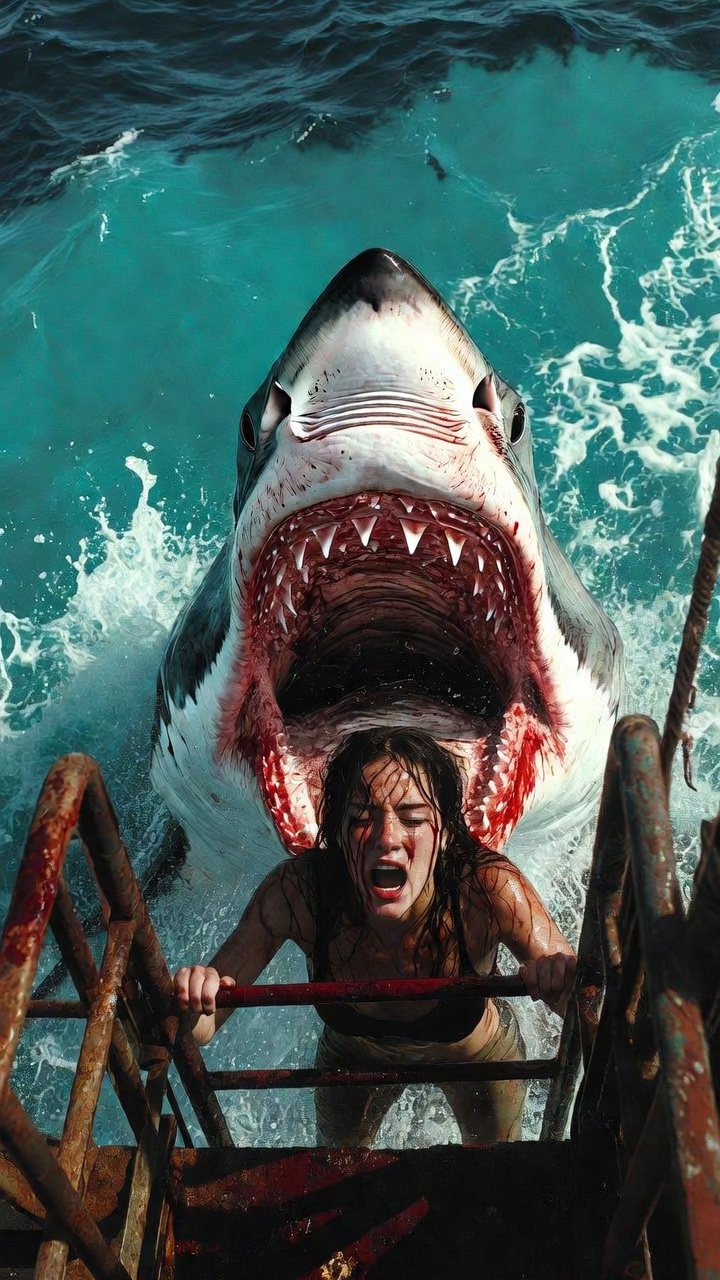
She gripped the first rung, her palms already slick with sweat and seawater. The cut on her hand wept blood, staining the metal in deep crimson smears. Each step upward was agony—her muscles burned, her breath came in ragged gasps. The ocean below was a churning teal abyss, waves crashing against the fort’s legs with rhythmic fury. She was halfway up when the water exploded.
Time seemed to slow, the world crystallizing into an ultra-cinematic nightmare. Close-up on Elara’s face: drenched in sweat and salt water, her eyes wide with raw terror, pupils dilated to pinpricks. Strands of hair plastered across her forehead, lips parted in a silent scream. She glanced down, and the horror unfolded in hyper-realistic detail—8K resolution, IMAX film grain adding a gritty authenticity to the textures of rust and foam.
Below her, the ocean surface erupted in a violent plume, high-speed water droplets frozen in mid-air like shattered diamonds suspended in time. The massive Great White Shark lunged upward, its colossal body propelled by raw power. From a dramatic low-angle perspective, the shark’s immense scale dominated the frame—its maw gaping wide, revealing rows upon rows of glistening, razor-sharp teeth, each one a serrated blade honed by evolution’s cruel hand. The sun’s harsh rays pierced the spray, creating deep shadows that accentuated the beast’s muscular form, its pale underbelly contrasting against the saturated teals of the sea. Vibrant blood reds from Elara’s wounds streaked the ladder, mirroring the shark’s bloodshot eyes.
The jaws snapped shut inches from her boots, the whoosh of displaced air whipping her legs. A tooth grazed the sole, tearing a chunk of rubber. Elara screamed, hauling herself up faster, her bloodied hands slipping on the rungs. The shark fell back with a thunderous splash, but it circled immediately, preparing for another strike. The fort vibrated from the impact, flakes of rust raining down like confetti from hell.
Adrenaline surged through her veins. « Not today, you bastard, » she muttered through gritted teeth. She climbed higher, the ladder groaning under the strain. Another lunge—this time, the shark’s fin clipped the lower rungs, bending them with a metallic screech. Elara’s foot slipped, and for a heart-stopping moment, she dangled by one hand, her body swinging precariously over the void. The shark’s shadow loomed below, a dark silhouette in the high-contrast waters.
Memories flashed: her team’s screams as their submersible imploded, the cold embrace of the deep claiming them. She wouldn’t join them. With a primal yell, she swung her leg back onto a rung and continued upward. The upper platform was tantalizingly close—ten feet, five, two. She pulled herself over the edge, collapsing onto the grated floor, chest heaving.
But safety was illusory. The shark rammed the fort again, the entire structure tilting slightly. Alarms blared from within—structural integrity failing. Elara activated her beacon, a faint hope in the vast emptiness. Hours passed under the unrelenting sun, her skin blistering, dehydration setting in. She bandaged her hand with strips from her wetsuit, but the blood loss weakened her.
Night fell, bringing no respite. The shark patrolled ceaselessly, its bioluminescent scars glowing in the dark like underwater lightning. Elara scavenged the turret for supplies: a flare gun, canned rations from a forgotten cache, and a rusted radio. Static crackled, but a voice broke through—a coast guard vessel, miles away, responding to her signal. « Hold on, we’re en route. ETA two hours. »
The wait was torture. The shark’s attacks grew more calculated, as if it sensed her vulnerability. One final assault shook the fort to its core—a support beam snapped, and the ladder she had climbed plummeted into the sea. Water flooded the lower levels, the structure listing dangerously.
As dawn broke, the rescue chopper appeared on the horizon, its rotors a symphony of salvation. Elara fired her flare, signaling her position. But the shark, enraged by the intrusion, leaped one last time, its body arcing through the air in a spectacular display of fury. The chopper’s downdraft scattered the spray, and a marksman fired tranquilizer darts into the beast, driving it back into the depths.
Elara was airlifted to safety, her body battered but alive. In the hospital, she reviewed her drone footage—the evidence of the Abyssal Strain irrefutable. But as she stared at the screen, the shark’s eyes seemed to stare back, a promise of unfinished business.
Years later, Elara returned to the sea, not as a hunter, but as a guardian. The forts were demolished, their secrets buried. Yet in her dreams, the ladder climb replayed: the sweat, the blood, the jaws snapping shut. The deep never forgets, and neither does she. In a world drowning in its own mistakes, survival was not victory—it was merely a pause before the next wave.