The Broken Lock

The Broken Lock
It was a gray, heavy afternoon in Bamako, the kind where red dust clings to your skin and the air feels thicker than usual. Karim’s hardware store, squeezed between a tailor’s shop and a small mosque in a narrow alley of Badalabougou, smelled of rusted metal and engine oil. The shelves groaned under the weight of padlocks, chains, screws, and forgotten tools. Karim wasn’t there that afternoon; it was his employee, Ibrahim, a forty-year-old man with a thin scar across his left cheek, who was minding the shop.
Ibrahim was sweeping the concrete floor when the door creaked open. A little girl stepped inside—no more than ten years old. She wore an oversized gray sweatshirt that hung off her thin shoulders, dirty pants with frayed hems, and her long blonde hair—unusual here, perhaps inherited from a European mother or distant mixed ancestry—was tied in a messy ponytail. Her large green eyes, full of fear, scanned the room as if searching for an invisible escape.

She went straight to the low shelf of padlocks. Not the cheap small ones—no: she picked the heaviest models, solid steel with thick shackles like a man’s fingers. She slipped two into the pockets of her sweatshirt, then hugged a third against her chest. Her small hands were shaking, but she made no sound.
Ibrahim had caught her out of the corner of his eye. He set the broom aside and approached slowly. “Little one, what are you doing?” he asked, voice calm but firm.
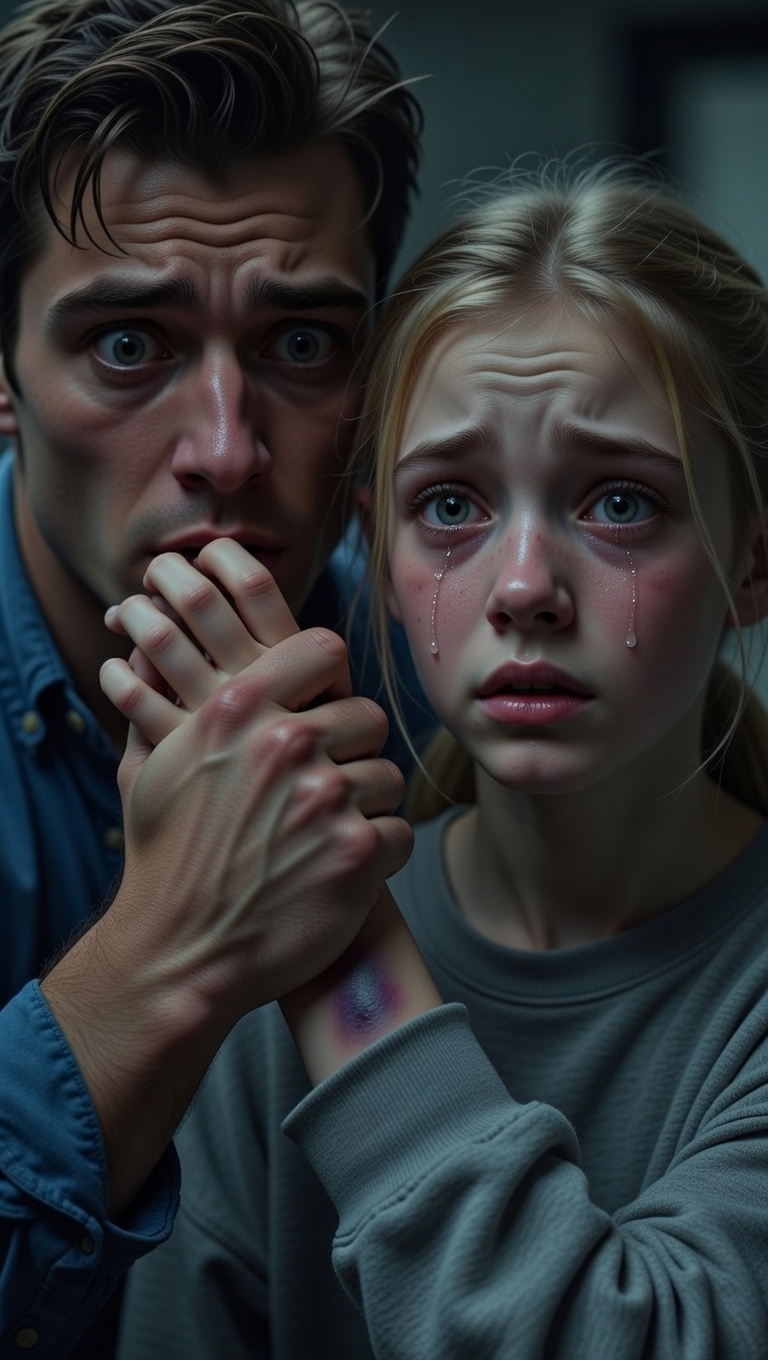
She startled, nearly dropping the padlock. Her eyes widened. Ibrahim reached out and gently caught her wrist—not roughly, just enough to stop her from running. That’s when he saw the marks.
Violaceous bruises, some fresh, some older, circled her thin wrist like a cruel bracelet. Fingerprints, clear and too large to belong to a child. Marks that told stories of muffled screams and slammed doors.
Ibrahim’s stomach twisted. He loosened his grip immediately. The girl didn’t move. She stared at the floor, tears welling but not yet falling. “I… I just wanted…” she whispered, voice breaking.
“Why the padlocks?” Ibrahim asked, softer now.
She lifted her eyes, and for the first time he saw something more terrifying than fear: a cold, almost adult determination. “To lock him in. So he can’t get out. Forever.”
Ibrahim understood in a flash. Not an ordinary thief. Not a kid stealing to eat. She wanted to lock someone away. And those bruises… they told him who.
He was about to call the police. His phone was already in his hand. But he hesitated. The girl—she later told him her name was Aïcha—was trembling all over now. “Please… don’t say anything. He’ll kill me. He always says he’ll kill me if anyone finds out.”
Ibrahim put the phone away. He crouched down to her level. “Who?”
She swallowed hard. “Dad.”
At that moment, the shop door opened again. A massive man stepped in, blocking the daylight. Angular face, dark brown eyes almost black, short hair, scar on his forehead. Stained t-shirt and cargo pants. He scanned the room and locked eyes on his daughter.
“Aïcha. Come. Now.”
The girl instinctively backed against the shelf. Ibrahim stood up and positioned himself between them without a word. The man—the father—took a heavy step forward. “She’s my kid. She took something? I’ll pay.”
Ibrahim didn’t budge. He was still holding one of the heavy padlocks Aïcha had dropped. He gripped it tighter. “She took them for a reason.”
The father gave a short, harsh laugh, but his eyes were hard. “Kids steal. That’s all.”
Aïcha whispered, almost inaudible: “He hits me… every night… he says it’s my fault… that Mom left because of me…”
Silence fell like a blade. Ibrahim looked at the bruises, then at the father, then back at the girl. He understood what she planned: go home, wait until her father passed out drunk, then lock the bedroom door from the outside. With those padlocks. So he couldn’t come in. So he couldn’t touch her. So she could breathe one full night without terror.
But he also knew it wouldn’t work. A man like that would kick the door down. Or worse.
In a few seconds, Ibrahim made his choice. He handed the padlock back to Aïcha. “Keep them.”
The father growled: “What the hell are you doing?”
Ibrahim stared him straight in the eyes. “I’m closing the shop. And you’re leaving. Without her.”
The man took a threatening step closer. Ibrahim didn’t flinch. He had been a soldier once; he knew that look. But he also knew violence wouldn’t solve anything today.
“Get out,” he repeated. “Or I call the police. And I show them her wrist.”
The father hesitated. He looked at his daughter, then at Ibrahim, then at the door. Finally, he spat on the floor and stormed out, cursing under his breath.
Aïcha was crying silently now. Ibrahim knelt again. “You’re not going home alone tonight. We’ll find help. An association, child protection police, a safe place.”
She nodded, tiny and fragile. “And the padlocks?”
Ibrahim gave a sad smile. “We’ll keep them. But not to lock a door. To lock away his power over you.”
Outside, the rain began to fall—rare and violent. Ibrahim closed the shop early. He took Aïcha’s hand—gently, without squeezing—and they stepped out together into the downpour. The padlocks weighed heavy in the girl’s pocket, heavy like a promise.
It wasn’t the end of the story. But it was the beginning of something: a door that would never again open onto fear.