The Reckoning at Table 7
The Reckoning at Table 7
I was sitting at table 8, close enough to hear every word, every clink of silverware, every stifled breath. The restaurant was one of those places where money buys silence—dim chandeliers, black velvet banquettes, candle flames flickering like they knew something was coming. Everyone dressed to disappear into elegance. Except him.
The man at table 7 was impossible to ignore. Mid-forties, angular face carved from entitlement, icy blue eyes that scanned the room like he owned it. He probably thought he did. Dark tailored suit, thin scar on his left cheek that looked like it came from a fight he won. He sat alone, scrolling his phone with one hand, the other drumming impatiently on the white linen. His espresso arrived. He barely glanced at the server who brought it.
The server was older—fifty-five maybe—round face, salt-and-pepper hair pulled back neatly, green eyes that stayed low and steady. Black uniform crisp, movements practiced and quiet. He set the small white cup down with care, offered a polite nod, and turned to leave.
That was when it happened.
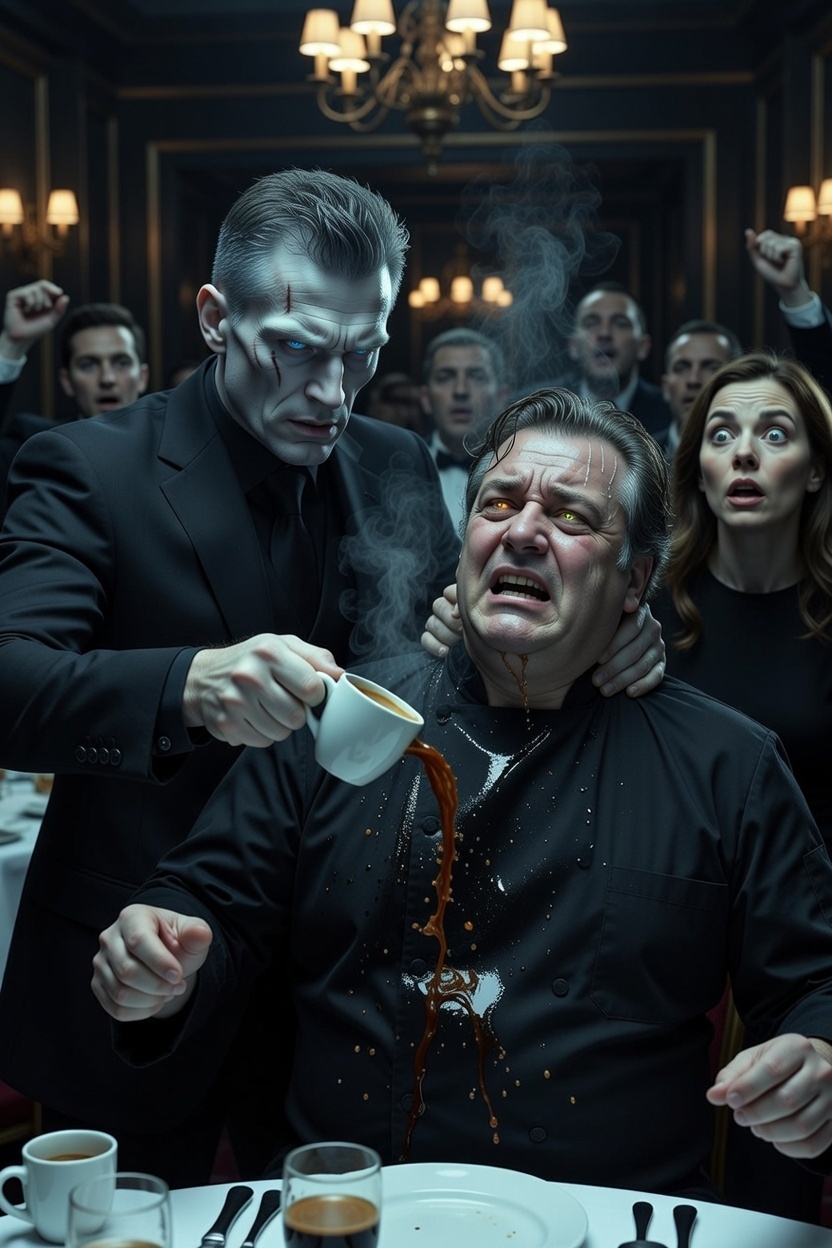
The manager—if that’s what he was—jerked his hand as if startled, though no one believed it was an accident. Hot espresso splashed across the server’s chest and arm. The man didn’t flinch. Instead, he looked up slowly, lips curling into something between a smirk and a sneer.
“Clumsy,” he said, loud enough for half the room to hear. “Clean it up.”
The server froze for half a second. Then he reached for a napkin from his apron.
“Not with that,” the man snapped. He pointed at the server’s own tie—black, silk, part of the uniform. “Use this. On your knees. My shoes got splashed too.”
A ripple went through the room. Forks paused. Conversations died mid-sentence. I felt my stomach turn. The woman beside me gripped her wine glass so hard her knuckles whitened. No one moved. No one spoke.
The server’s jaw tightened. A bead of sweat appeared at his temple. He looked down at the man’s polished oxfords—now speckled with coffee—then back at the face staring up at him with cold amusement. Slowly, deliberately, he lowered himself to one knee, then the other. The fabric of his trousers stretched across the marble floor. He loosened his tie with trembling fingers, pulled it free, and began to wipe the shoes.
The man leaned back in his chair, crossed his arms, and watched. “Harder,” he said. “I want to see my reflection.”
Tears welled in the server’s eyes. One escaped, traced a line down his cheek, dripped onto the leather. He kept wiping. The restaurant was so quiet I could hear the soft scrape of silk on shoe, the ragged edge of the server’s breathing.
Minutes passed like hours. Finally the man waved a dismissive hand. “Enough. Get out of my sight.”
The server rose, tie crumpled and stained in his fist. He walked away without a word, shoulders rigid, head high despite everything. The room exhaled. A few people whispered. Most just stared at their plates, ashamed.
Ten minutes later the double doors at the far end of the dining room opened again.
He walked in alone.
Same height, same build, same salt-and-pepper hair—now swept back with quiet authority. But the uniform was gone. In its place: a perfectly cut black suit that cost more than most people’s cars. No tie. Open collar. The green eyes that had been lowered before now burned with something cold and final.
He didn’t rush. He crossed the room at a measured pace, footsteps deliberate on the marble. Every head turned. The manager at table 7 looked up—casual at first—then froze. Color drained from his face so fast it looked like someone had pulled a plug. His hands, resting on the table, began to shake. A glass tipped. Red wine spread across the linen like blood.
The man in the black suit stopped directly in front of table 7. He didn’t raise his voice. He didn’t need to.
“You’re fired,” he said simply.
The manager opened his mouth. Nothing came out.
“And when security escorts you out,” the owner continued, “you’ll be walking past every person in this room who just watched you humiliate one of my staff. One of me.”
He leaned in slightly. “I own this building. I own the company you work for. I own the chain you thought gave you power. And tonight… I own your career.”
The manager’s legs buckled. He dropped back into the chair, hands covering his face. Shoulders heaving. Silent sobs.
No one clapped. No one cheered. The room stayed deathly still.
The owner straightened, glanced around once—at all of us who had done nothing—and then walked away.
I haven’t been back to that restaurant since.
But I still see it every time I close my eyes: the tie in trembling hands, the tears on marble, the moment a man who thought he was untouchable realized he had just destroyed himself in front of everyone who mattered.
What happened to the manager after that night? The rumors say he never worked in the industry again. Some say he disappeared from the city entirely.
But the real question isn’t what happened to him.
It’s what would you have done if you’d been sitting at table 8?